
Ferrari Have Blown It Again: Only Christian Horner Can Fix This Mess and the Lewis Hamilton Problem
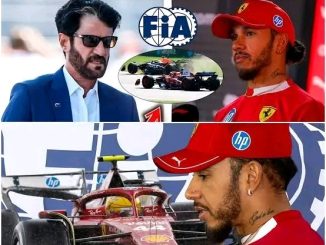
Ferrari’s latest Formula 1 crisis has reached a point where the conversation is no longer simply about car performance. It is about leadership, race management, internal discipline and, increasingly, how the team is handling Lewis Hamilton.
The Italian Grand Prix at Monza was supposed to be Ferrari’s great opportunity to deliver in front of its passionate home crowd. Instead, the Scuderia left Monza with another painful reminder that having two world-class drivers and a famous red car means very little if the team cannot consistently execute when it matters most.
Hamilton finished sixth after an opening-lap clash with Charles Leclerc, while Leclerc’s race ended after crashing on the following lap. Kimi Antonelli, starting from 19th, went on to produce a remarkable victory for Mercedes, extending his championship advantage over Hamilton to 76 points with 10 races remaining.
For Ferrari, the problem is now much bigger than one bad Sunday.
Monza exposed Ferrari’s biggest weakness
The most damaging aspect of Ferrari’s Monza weekend was not simply the result. It was the sense that the team still lacks the operational structure required to turn potential into championship results.
Hamilton had already expressed frustration with Ferrari’s execution during qualifying, when the team failed to convert its expected competitiveness at its home circuit into pole-position contention. Ferrari ultimately had Charles Leclerc third and Hamilton fourth on the adjusted grid, while Pierre Gasly stunned the paddock by taking pole for Alpine.
Then came the race.
Hamilton and Leclerc collided on the opening lap, with Hamilton forced off track and Leclerc eventually crashing out. Hamilton argued that Ferrari needed clearer internal rules governing how its drivers race each other.
That criticism is particularly significant because Hamilton knows what a highly structured championship operation looks like.
During his Mercedes years, there were established procedures for managing team-mate battles, strategy calls and championship priorities. At Ferrari, Hamilton is discovering that the legendary Scuderia still has areas where improvisation can replace discipline.
And that is precisely where the Christian Horner discussion becomes interesting.
Why Christian Horner keeps entering the conversation
The idea of Christian Horner joining Ferrari is not new.
Horner has previously been linked with a move to Maranello, and there have even been calls for Ferrari to consider him as the man capable of transforming the organisation. Former F1 driver Juan Pablo Montoya has publicly backed the idea of Ferrari making a move for Horner.
There is also evidence that the possibility has been taken seriously enough to generate persistent speculation around the paddock.
But there is an important distinction between “Horner can fix Ferrari” and “Ferrari should definitely hire Horner.”
The first is an argument about leadership qualities.
The second would be a massive organisational decision.
Horner’s biggest strength has always been his ability to build a competitive political and operational environment around a Formula 1 team. At Red Bull, he helped oversee an organisation that transformed from a midfield project into a championship-winning powerhouse.
That experience is exactly what makes his name attractive whenever Ferrari finds itself struggling with internal coordination.
And then there is Lewis Hamilton
Hamilton’s situation makes the story even more complicated.
The seven-time world champion did not join Ferrari simply to add another famous name to the team’s history. He arrived with the expectation of competing for victories and, ultimately, another world championship.
Instead, the Italian Grand Prix has left him effectively admitting that his 2026 title hopes have suffered a major blow.
Hamilton is now 76 points behind Antonelli in the championship with 10 rounds still remaining. Ferrari remains second in the constructors’ championship, but Mercedes is ahead, while Ferrari’s two-driver operation has again failed to maximise its opportunities.
Hamilton’s frustration is therefore understandable.
He does not simply need a faster Ferrari.
He needs a Ferrari that operates like a championship team.
That means better communication, clearer driver-management protocols, stronger strategic decisions and fewer avoidable mistakes.
Could Horner actually solve the Hamilton problem?
This is where the headline becomes more complicated than the reality.
There is currently no confirmation that Christian Horner is coming to Ferrari to replace Fred Vasseur. In fact, previous speculation linking Horner with Ferrari has been described by Hamilton himself as a distraction.
So presenting a Horner-Ferrari takeover as a done deal would be misleading.
But the underlying question is legitimate.
Would Ferrari benefit from someone with Horner’s management experience?
Potentially, yes.
Horner understands how to manage star drivers, engineers, political pressure and championship expectations simultaneously. His Red Bull tenure demonstrated that he can operate in an environment where every decision is scrutinised and where internal competition can become just as dangerous as the opposition.
That experience could theoretically help Ferrari establish the kind of framework Hamilton is now demanding.
However, Horner would not magically make Ferrari’s problems disappear.
The car would still need to be competitive.
The engineering department would still need to deliver.
Strategists would still have to make the right calls.
And Hamilton and Leclerc would still have to race each other intelligently.
Ferrari cannot blame everything on Hamilton
There is another uncomfortable truth Ferrari must confront.
It would be wrong to turn Hamilton into the scapegoat.
Yes, the Briton’s move to Ferrari came with enormous expectations. Yes, his performances are being judged against his legendary Mercedes career. And yes, mistakes from the driver have contributed to some difficult weekends.
But Monza demonstrated that Ferrari’s problems are bigger than one driver.
Leclerc’s retirement and Hamilton’s sixth-place finish cannot simply be explained as evidence that Hamilton is struggling.
The team has failed to consistently convert opportunities.
Even before the race, Hamilton had questioned Ferrari’s execution in qualifying.
After the race, he called for written rules of engagement.
That is not the language of a driver simply complaining about his car.
It is the language of a driver asking his organisation to become more professional.
The Vasseur question
Fred Vasseur now faces one of the most important periods of his Ferrari career.
The Frenchman has the difficult job of deciding whether the answer is continuity or major structural change.
Ferrari cannot afford to panic after one race. But neither can it ignore a pattern.
The Scuderia currently has two hugely talented drivers, enormous resources and one of the most passionate fanbases in world sport.
Yet Mercedes left Monza celebrating a spectacular victory after Antonelli recovered from 19th to first.
That is the kind of result that should force Ferrari to ask serious questions.
Not just about the drivers.
About everything.
The real Ferrari problem
The real problem is not Lewis Hamilton.
It is not Charles Leclerc.
And it may not even be Fred Vasseur.
The deeper problem is that Ferrari still occasionally behaves like a team capable of winning races rather than an organisation designed to win championships.
Those are two very different things.
A championship operation must eliminate unnecessary chaos.
It must establish clear rules before the pressure arrives.
It must protect its drivers from avoidable internal conflict.
And when mistakes happen, it must learn from them immediately.
That is why Horner’s name continues to attract attention.
Whether he ever joins Ferrari or not, the former Red Bull boss represents something Ferrari desperately needs: ruthless organisational clarity.
Hamilton’s future now depends on Ferrari’s response
Hamilton is not finished.
Ten races remain, and Formula 1 can change dramatically over a single weekend.
But Ferrari has to give him a reason to believe.
The Briton has already made clear that he wants clearer rules after the Leclerc incident.
Now the responsibility shifts to Ferrari’s leadership.
If the Scuderia responds by strengthening its internal structure, improving communication and giving both drivers clear boundaries, Monza could eventually become the race that forced Ferrari to change.
If nothing changes, however, the criticism will become much louder.
And that is the uncomfortable reality facing Ferrari.
The problem is no longer whether Hamilton is good enough. The question is whether Ferrari is organised enough to give a seven-time world champion the environment he needs to fight for an eighth title.
Christian Horner may not be the man who ultimately walks through Ferrari’s doors.
But after another weekend of chaos, the fact that his name is being mentioned tells its own story.
Ferrari does not necessarily need Horner.
It needs what Horner represents: leadership, structure, discipline and the ability to turn enormous talent into championship results.
And unless Ferrari finds those qualities quickly, the greatest danger is not losing one race at Monza.
It is wasting another championship opportunity.
Discover more from F1 Paddock Updates
Subscribe to get the latest posts sent to your email.


Be the first to comment