
FIA Hungarian GP Then vs Now: From Senna’s Era to Lewis Hamilton’s Record-Breaking Reign
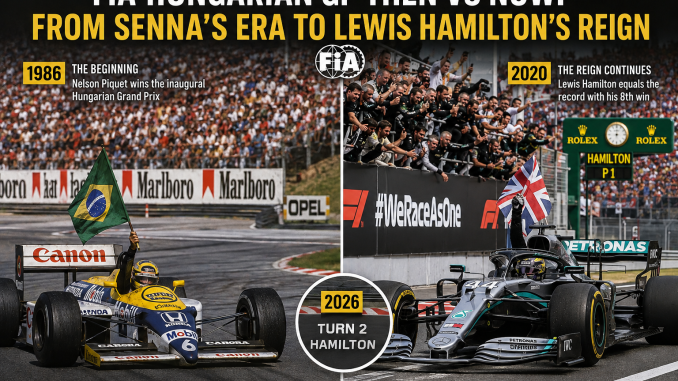
The Hungarian Grand Prix has travelled a remarkable road since Formula 1 first arrived at the Hungaroring in 1986. Forty years later, the circuit has become closely associated with Lewis Hamilton, who holds the record for the most victories at the Budapest venue.
The story began in 1986, when Nelson Piquet won the inaugural Hungarian Grand Prix for Williams-Honda. The race was historically significant because it was the first Formula 1 event held in Hungary and the first Grand Prix staged behind the Iron Curtain. Piquet defeated Ayrton Senna after a memorable battle, while Nigel Mansell completed the podium.
The early years of the Hungarian Grand Prix were shaped by some of Formula 1’s biggest names. Piquet won the first two races, while drivers such as Senna, Mansell, Alain Prost and Michael Schumacher later added their own chapters to the circuit’s history.
Mansell’s connection with Hungary became particularly significant in 1992, when he secured his first and only Formula 1 world championship at the Hungaroring. Decades later, the circuit would give Hamilton an even stronger connection with the venue.
Hamilton first won the Hungarian Grand Prix in 2007 with McLaren. He later added victories in 2009 and 2012 before continuing his success with Mercedes in 2013, 2016, 2018, 2019 and 2020. His 2020 victory gave him eight wins at the circuit, establishing him as its most successful driver. Formula 1 records Hamilton’s eight victories and nine pole positions at the Hungaroring.
The contrast between the old and modern eras is striking. The Hungaroring of 1986 was a new circuit hosting a historically important race, while today’s event is a major international sporting spectacle featuring advanced cars, sophisticated technology and global television coverage.
The 2026 season provided another remarkable chapter. To celebrate the Hungarian Grand Prix’s 40th anniversary, the Hungaroring officially named all 14 corners after important figures, places and features connected with the circuit. Turn 1 was named after Piquet, while Turn 4 carries Mansell’s name. Most significantly for Hamilton, Turn 2 was named after him in recognition of his extraordinary record at the track.
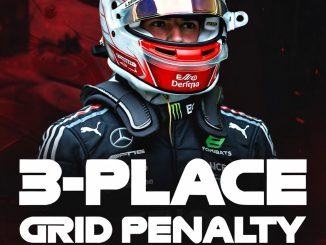
Hamilton entered the 2026 Hungarian weekend hoping to add a ninth victory, but the race did not produce another Hamilton triumph. Lando Norris won for McLaren, with Max Verstappen finishing second and Kimi Antonelli third. Hamilton finished fifth after a three-place grid penalty following qualifying, meaning his record remained at eight Hungarian GP victories.
That result provides the perfect comparison between then and now. In 1986, Piquet was creating history by winning Hungary’s first Formula 1 race. Forty years later, Hamilton was being permanently recognised at the same circuit because of the records he had built there.
From Piquet and Senna to Mansell, Schumacher and Hamilton, the Hungarian Grand Prix has evolved from a groundbreaking new addition to the F1 calendar into one of the sport’s most historically significant venues. Hamilton may not have won the 40th-anniversary race, but with his name now attached to Turn 2, his legacy at the Hungaroring is firmly written into the circuit itself.
Discover more from F1 Paddock Updates
Subscribe to get the latest posts sent to your email.

Be the first to comment