
From Lauda to Verstappen: How the Dutch Grand Prix Went From F1’s Final Old-School Race to a Modern Spectacle
The Dutch Grand Prix has undergone one of the most remarkable transformations in Formula 1 history. The contrast between the final race of the old Zandvoort era in 1985 and the modern Dutch Grand Prix shows just how much Formula 1 has changed over the decades.
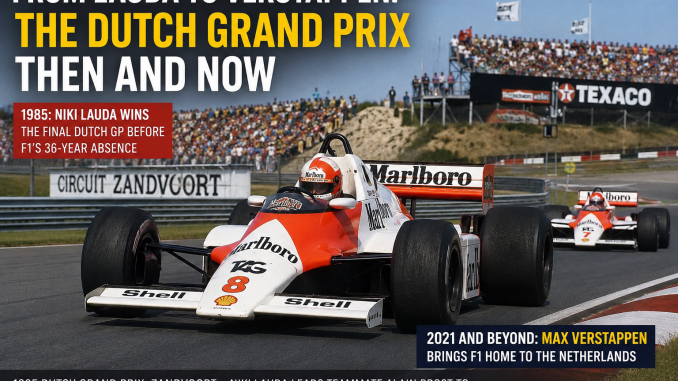
On August 25, 1985, Niki Lauda claimed victory at Zandvoort for McLaren. It was not just another win for the Austrian—it became the 25th and final Grand Prix victory of his career. Lauda finished just 0.232 seconds ahead of his McLaren teammate Alain Prost, while Ayrton Senna completed the podium for Lotus.
The race also marked the end of an era. Formula 1 would not return to Zandvoort for another 36 years. Financial problems surrounding the circuit and changes to the venue eventually removed the Dutch Grand Prix from the F1 calendar.
The atmosphere of that period was very different from today’s Formula 1. The cars were dramatically different, the circuits were generally less modern, and drivers such as Lauda, Prost and Senna were competing during a fiercely competitive period of the sport.
Fast-forward to 2021 and Zandvoort finally returned to the Formula 1 calendar. This time, the home crowd had a Dutch driver to celebrate. Max Verstappen started from pole position and won the race for Red Bull, becoming the first Dutch driver to win his home Grand Prix. Lewis Hamilton finished second for Mercedes, with Valtteri Bottas third.
The comparison between Lauda’s 1985 victory and Verstappen’s 2021 triumph could hardly be more striking. Lauda’s victory represented the closing chapter of Zandvoort’s first F1 era, while Verstappen’s success symbolised the beginning of a new chapter.
There is also a fascinating McLaren connection. In 1985, McLaren dominated the top two positions, with Lauda winning and Prost finishing second. Decades later, McLaren returned to the winners’ circle at Zandvoort when Lando Norris won the 2024 Dutch Grand Prix. McLaren itself notes that Lauda’s 1985 victory was the team’s fourth at the circuit before Norris added another decades later.
That history gives the Dutch Grand Prix a unique place on the F1 calendar. What was once the setting for Lauda’s final victory has become one of the defining venues of the modern Verstappen era.
The biggest difference, however, is not simply the drivers or teams. It is the evolution of Formula 1 itself. The sport has moved from the technology and racing culture of the 1980s into an era dominated by advanced aerodynamics, sophisticated data analysis, modern safety standards and enormous global attention.
Zandvoort therefore offers more than a race. It provides a direct comparison between two generations of Formula 1. In 1985, Lauda closed the book on an era with McLaren. More than three decades later, Verstappen reopened that book in front of an enthusiastic home crowd.
The question is no longer whether the Dutch Grand Prix belongs in Formula 1 history. It is how much the event—and the sport around it—has changed since Lauda’s final victory.
Discover more from F1 Paddock Updates
Subscribe to get the latest posts sent to your email.

Be the first to comment