
When Football Lost Its Kings: Remembering the Legends Who Changed the Beautiful Game
Football has always been more than a game. Across generations, extraordinary players have transformed the sport through their talent, personality and unforgettable achievements. Some of those icons have now passed away, but their influence remains deeply woven into football’s history.
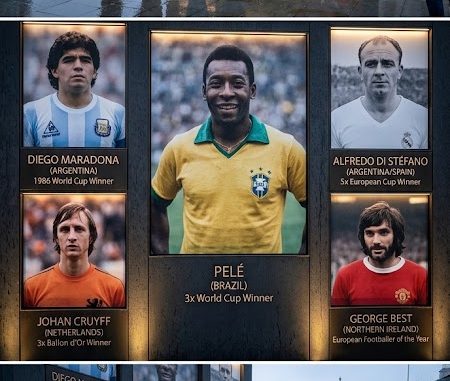
Among the greatest names ever to grace the game is Brazil’s Pelé, widely remembered as the “King of Football.” Born Edson Arantes do Nascimento in 1940, Pelé rose from humble beginnings to become a global sporting icon. He joined Santos as a teenager and quickly established himself as one of the most gifted forwards of his generation.
Pelé’s greatest international achievement came with Brazil. He won the FIFA World Cup in 1958, 1962 and 1970, making him the only player to win the tournament three times. His performances, goals and creativity helped turn him into a worldwide symbol of Brazilian football. He later continued his career with the New York Cosmos before retiring from professional football.
Pelé died on December 29, 2022, at the age of 82. His passing marked the end of an extraordinary life, but not the end of his influence. His name continues to represent excellence, imagination and the global appeal of football.
Another giant of the sport was Argentina’s Diego Maradona. Renowned for his extraordinary dribbling, vision and ability to control matches, Maradona became one of football’s most influential figures. His greatest achievement came at the 1986 World Cup, where he captained Argentina to the title and won the tournament’s Golden Ball.
Maradona’s club career was equally memorable, particularly his time with Napoli. He helped the Italian club win its first Serie A championship and became a legendary figure among its supporters. He died in November 2020 at the age of 60, leaving behind a football legacy that continues to inspire debate and admiration.
The Netherlands also produced one of football’s greatest innovators, Johan Cruyff. More than an exceptional player, Cruyff became one of the most influential thinkers in the sport. He was a central figure in the Total Football philosophy and won three Ballon d’Or awards.
Cruyff achieved major success with Ajax and later Barcelona, both as a player and manager. His ideas about movement, possession and attacking football influenced generations of coaches and players. He died in 2016, but his football philosophy continues to shape the modern game.
Before Pelé’s global dominance, Alfredo Di Stéfano was already establishing himself as one of football’s greatest stars. The Argentine-born forward became a defining figure at Real Madrid during one of the club’s most successful early eras. His versatility, intelligence and goal-scoring ability made him a complete footballer.
Di Stéfano died in 2014 at the age of 88. His legacy remains particularly strong at Real Madrid, where he is remembered as one of the most important players in the club’s history.
George Best represented another kind of football genius. The Northern Irish winger became famous for his extraordinary dribbling, creativity and flair, particularly during his Manchester United career. He helped United win major honours and became one of the most recognisable footballers of his generation.
Best died in 2005, aged 59. Despite the difficulties he experienced away from the pitch, his footballing brilliance remains an important part of Manchester United’s history.
These legends came from different countries and different generations, but they shared something powerful: they changed how people understood football.
Pelé brought worldwide fame to the sport through his extraordinary performances. Maradona demonstrated how one player could inspire an entire nation. Cruyff helped revolutionise football’s tactical thinking. Di Stéfano helped establish Real Madrid as a European powerhouse, while Best showed how individual flair could captivate millions.
Their careers eventually ended, and their lives eventually came to an end, but their football did not disappear with them.
Every generation of supporters continues to discover their goals, skills, trophies and stories. Young players still study their movements, coaches still discuss their ideas, and fans still debate where they belong among football’s greatest ever figures.
The names may belong to the past, but the memories remain alive.
That is the extraordinary power of football: a player can leave the pitch forever, yet become immortal through the history of the game.
Discover more from F1 Paddock Updates
Subscribe to get the latest posts sent to your email.

Be the first to comment