
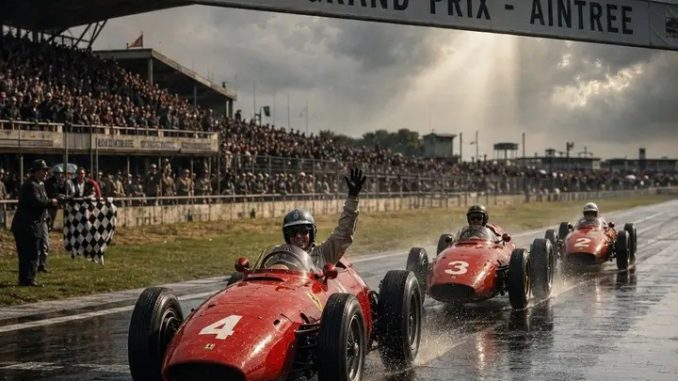
July 15 in Formula 1 History: Ferrari Glory, Historic Milestones and a Shocking Ret… read more 👇 full details in the comments
July 15 has delivered some of the most memorable moments in Formula 1 history. The date has seen dominant victories, groundbreaking technical achievements, heartbreaking disappointments, and surprising announcements that left fans around the world stunned. From Ferrari’s commanding performance in the early 1960s to Nigel Mansell’s emotional retirement declaration nearly three decades later, this day remains one of the sport’s most fascinating chapters.
Ferrari Dominates the 1961 British Grand Prix
The 1961 British Grand Prix, held at the famous Aintree circuit on July 15, produced one of Ferrari’s most impressive performances. The race took place under constantly changing weather conditions, with sunshine giving way to rain and then back again, creating a difficult challenge for every driver on the grid.
Despite the unpredictable conditions, Ferrari proved to be in a class of its own. Wolfgang von Trips claimed victory, while teammate Phil Hill finished second and Richie Ginther completed an outstanding Ferrari 1-2-3 finish. It was a perfect afternoon for the Italian team and another demonstration of its superiority during the 1961 season.
British hero Stirling Moss kept the Ferrari drivers under pressure for much of the race and thrilled the home crowd with another determined performance. Unfortunately, his challenge came to an abrupt end after suffering brake failure, forcing him to retire before the finish.
Von Trips’ victory proved especially significant because it moved him to the top of the Drivers’ Championship standings. Sadly, the triumph would later become even more emotional in hindsight. Just two races later, during the Italian Grand Prix at Monza, von Trips was involved in a tragic accident that claimed his life. As a result, his success at Aintree became both his second and final Formula 1 victory, forever securing a bittersweet place in the sport’s history.
A Race That Changed Formula 1 Engineering
The 1961 British Grand Prix was memorable for far more than Ferrari’s dominance. It also marked two historic technical milestones that remain important in Formula 1 history.
Jack Fairman competed in the Ferguson P99, making it the first four-wheel-drive (4WD) car ever to race in a Formula 1 World Championship event. While four-wheel drive never became a lasting solution in Formula 1, the Ferguson P99 demonstrated engineers’ willingness to explore new ideas in the search for greater performance.
The same event also marked the final appearance of a front-engined Formula 1 car in a World Championship race. By that stage, rear-engined designs had already become the future of the sport because they offered better balance, handling and performance. The 1961 British Grand Prix therefore became the unique occasion where Formula 1 witnessed both the arrival of a new engineering concept and the end of one of its oldest eras on exactly the same day.
Nigel Mansell’s Emotional 1990 Announcement
Exactly 29 years later, July 15 once again became a landmark date in Formula 1. The 1990 British Grand Prix at Silverstone delivered both excitement on the circuit and dramatic headlines after the race.
Nigel Mansell started from pole position and immediately delighted the home crowd by building a comfortable lead. It looked as though the British driver was on course for an unforgettable victory in front of thousands of passionate supporters.
However, disaster struck with only eight laps remaining. A gearbox failure forced Mansell to retire, ending what had appeared to be a certain victory.
The race win instead went to Ferrari’s Alain Prost, who capitalized on Mansell’s misfortune to claim another important victory for the Scuderia.
Yet the biggest story of the day came after the chequered flag. Standing alongside his family, Mansell unexpectedly announced that he intended to retire from Formula 1 at the end of the season. The declaration shocked fans, journalists and rival teams alike, as few had anticipated such a decision from one of the sport’s biggest stars. Although Mansell would later return to Formula 1 and eventually become world champion, his emotional announcement remains one of the most surprising moments in British Grand Prix history.
The 1990 event also marked the final Formula 1 race held on Silverstone’s original high-speed layout. Soon after the Grand Prix, work began to redesign the circuit, introducing slower corners and improving safety. The changes transformed one of Formula 1’s most iconic venues while preserving its place as a favourite among drivers and fans.
Born on This Day: Prince Bira
July 15 is also remembered as the birthday of Prince Bira of Thailand, who was born in 1914. Competing in Formula 1 between 1950 and 1954, Prince Bira became one of the sport’s pioneering international competitors and remains an important figure in Asian motorsport history.
His finest World Championship result came in 1950, when he finished fourth overall, helping establish his reputation as one of the leading drivers of Formula 1’s earliest years.
From Ferrari’s historic clean sweep and groundbreaking engineering achievements to Nigel Mansell’s unforgettable retirement announcement and the legacy of Prince Bira, July 15 continues to stand as one of the most remarkable dates in Formula 1 history—a day filled with triumph, innovation, heartbreak and unforgettable memories.
Be the first to comment