
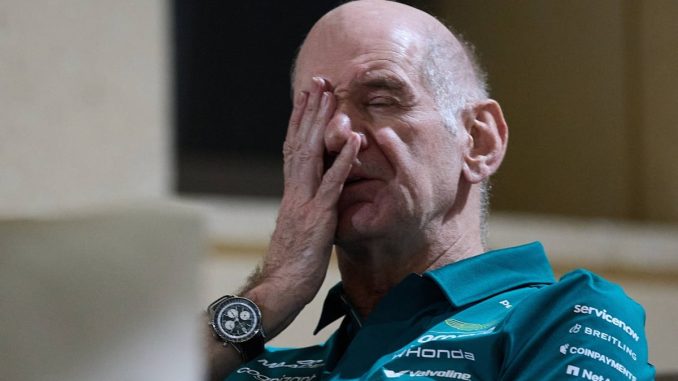
Aston Martin’s Adrian Newey Gamble Could Bring Glory—or Serious T… read more 👇 full details in the comments
Aston Martin’s ambitious decision to place legendary Formula 1 designer Adrian Newey at the center of its future project has sparked intense debate across the paddock. While Newey’s arrival has generated enormous excitement, several Formula 1 insiders have warned that relying too heavily on one individual could leave the team facing significant challenges if the strategy does not deliver immediate results.
The Silverstone-based outfit has invested heavily over the past few years, transforming its facilities and recruiting top talent in an effort to become a genuine championship contender. Newey’s arrival is widely viewed as the final piece of that puzzle, especially with Formula 1 preparing for sweeping regulation changes. However, experienced voices within the sport believe the plan carries considerable risks.
Newey has built a remarkable reputation after decades of designing race-winning and championship-winning cars. His influence has been felt at Williams, McLaren, and most recently Red Bull, where his technical expertise helped create one of Formula 1’s most dominant eras. Naturally, Aston Martin hopes he can repeat that success under its banner.
Despite his impressive résumé, insiders caution that modern Formula 1 has become too complex for one individual to guarantee success. Car development now depends on hundreds of engineers working across multiple departments, including aerodynamics, power unit integration, simulation, manufacturing, and race operations. While Newey can provide exceptional leadership and innovative ideas, turning those concepts into championship-winning machinery requires flawless teamwork throughout the organization.
Some experts fear Aston Martin may be placing unrealistic expectations on the renowned designer. If the team struggles under the new regulations, criticism could quickly grow around a project that many currently view as Formula 1’s most exciting long-term investment.
The challenge becomes even greater because the 2026 technical regulations represent one of the biggest rule changes in recent history. Every team will essentially begin from a clean sheet, meaning previous advantages could disappear overnight. Although Newey has an outstanding record of adapting to rule changes, success is never guaranteed when every rival is also developing entirely new concepts.
Another concern highlighted by paddock observers is timing. Building a title-winning Formula 1 team is rarely an overnight process. Even with world-class facilities, elite personnel, and substantial financial backing, success often requires years of refining processes and improving communication between departments. If Aston Martin expects immediate victories simply because Newey has joined the project, disappointment could follow.
The team’s partnership with Honda for the new engine regulations also introduces another layer of complexity. Chassis and power unit development must work perfectly together, requiring close collaboration between engineers based in different countries. Any delay or mismatch between the two projects could compromise overall performance during the crucial opening stages of the new era.
Pressure will also increase on drivers Fernando Alonso and Lance Stroll. Alonso remains one of Formula 1’s most experienced competitors and continues to demonstrate exceptional speed despite his age. However, he will expect Aston Martin’s massive investment to produce a car capable of fighting consistently at the front rather than merely challenging for occasional podium finishes.
Meanwhile, Aston Martin owner Lawrence Stroll has shown a willingness to invest whatever is necessary to transform the team into championship contenders. From constructing a state-of-the-art factory and wind tunnel to recruiting respected technical figures, the commitment has been undeniable. Yet Formula 1 history is filled with examples of well-funded projects that failed to meet expectations despite attracting some of the sport’s brightest minds.
Supporters of Aston Martin argue that Newey’s arrival should still be viewed as a major positive rather than a potential problem. His experience, creativity, and ability to inspire engineering teams have consistently produced innovative solutions throughout his career. Even if success is not immediate, many believe his influence will strengthen the team’s long-term technical direction.
Ultimately, Aston Martin’s future may depend on how effectively it combines Newey’s genius with the broader capabilities of its engineering department. If every element of the organization works together, the team could emerge as a genuine championship force under Formula 1’s new regulations. But if expectations become unrealistic or key areas fail to match Newey’s vision, Aston Martin could find itself enduring the “world of pain” that some insiders have warned about.
The coming seasons will reveal whether Aston Martin’s bold gamble becomes one of Formula 1’s greatest success stories—or a costly lesson in the dangers of relying too heavily on even the sport’s most celebrated designer.
Be the first to comment