
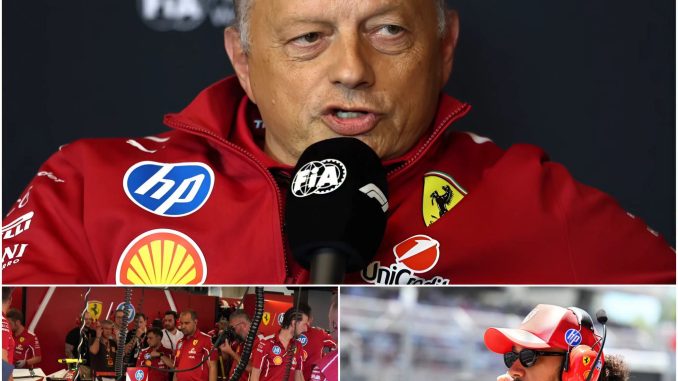
“WE SIMPLY CAN’T AFFORD IT ANYMORE” — FRED VASSEUR ISSUES STARK WARNING AS FERRARI’S TITLE HOPES HANG IN THE BALANCE
Ferrari team principal Fred Vasseur has reportedly delivered a blunt warning to his team as the Scuderia attempts to keep its 2026 Formula 1 championship ambitions alive, with the Frenchman making it clear that Ferrari can no longer afford to throw away valuable opportunities.
Lewis Hamilton’s arrival at Ferrari was expected to transform the Italian team into an immediate championship contender, but the reality has been considerably more complicated. Although Ferrari has made significant progress with its 2026 machinery, the team has continued to lose important points through a combination of strategy problems, operational mistakes and inconsistent execution.
With the championship battle becoming increasingly intense, every lost point could eventually prove decisive.
Vasseur has therefore stressed the importance of Ferrari eliminating the errors that have repeatedly prevented the team from converting strong pace into maximum results.
The message coming from Maranello is straightforward: Ferrari cannot continue relying solely on the speed of the car.
The SF-26 has demonstrated enough performance to challenge the leading teams on several occasions, but outright pace is only one part of the championship equation. A Formula 1 title requires consistency across qualifying, race strategy, pit stops, tyre management, reliability and decision-making.
For Hamilton, that reality is particularly important.
The seven-time world champion joined Ferrari with the ultimate objective of winning an eighth drivers’ championship. After a difficult first season adapting to life in red, the 2026 campaign was expected to provide a much stronger platform.
Ferrari has indeed given Hamilton a significantly more competitive car, and his first victory for the team provided an emotional breakthrough. However, isolated victories are not enough. Hamilton needs Ferrari to deliver consistently if he is to remain in realistic contention for the championship.
That is where Vasseur’s warning becomes significant.
One of Ferrari’s most persistent problems has been its inability to extract the maximum possible result from weekends when the car is competitive. At times, strategic decisions have placed the drivers in difficult situations, while other races have exposed weaknesses in Ferrari’s ability to respond quickly when circumstances change.
Those mistakes become particularly expensive when competing against teams capable of collecting points almost every weekend.
Mercedes, in particular, has demonstrated the importance of operational consistency. Even when a Mercedes car is not necessarily dominant, strong execution can allow the team to collect a substantial haul of points.
Ferrari cannot afford to give its rivals that advantage.
Vasseur has spent much of his tenure attempting to change Ferrari’s internal culture, particularly the way decisions are made under pressure. The Frenchman has repeatedly emphasized the importance of avoiding emotional reactions and building a more disciplined organization.
That philosophy is becoming increasingly important as the championship enters its decisive phase.
For Hamilton, the stakes could hardly be higher.
An eighth world championship would move him beyond Michael Schumacher and make him the outright record holder for drivers’ titles. Hamilton has already equalled Schumacher’s record of seven championships, but the opportunity to stand alone at the top has remained one of the biggest ambitions of his career.
Ferrari represents perhaps the most intriguing route to achieving it.
Winning a championship with Ferrari would not simply add another title to Hamilton’s record. It would complete one of the most remarkable chapters in Formula 1 history, combining his record-breaking career with the sport’s most famous team.
However, Ferrari must first eliminate the weaknesses that continue to undermine its progress.
The pressure on Vasseur is also increasing.
As team principal, he is responsible for creating an environment in which Ferrari’s technical strength can be converted into championship results. That means identifying whether the recurring problem lies primarily in race strategy, communication, pit-wall decision-making, development direction or the execution of individual race weekends.
Whatever the answer, Ferrari cannot afford to allow the same mistakes to continue.
The encouraging factor is that the team clearly possesses the underlying performance required to fight near the front.
Hamilton and Charles Leclerc have both demonstrated the ability to extract strong performances from the SF-26, while Ferrari’s development programme has continued to produce improvements. The challenge now is turning that potential into sustained results.
Vasseur’s message therefore represents more than criticism of one isolated incident.
It is a warning that Ferrari’s margin for error is disappearing.
When fighting for a championship, a missed opportunity can be worth far more than the points lost on a single Sunday. A poor strategic call can affect the standings, momentum and confidence, while allowing a rival to gain ground without necessarily having the fastest car.
That is exactly the situation Ferrari must avoid.
Hamilton will also know that time is not on his side. At this stage of his career, every championship opportunity carries additional significance. Ferrari may provide him with another chance in the future, but there is no guarantee that the team will remain this competitive or that another title opportunity will present itself.
That makes the remainder of the 2026 season crucial.
Ferrari has the speed.
Hamilton has the experience.
Leclerc has the talent.
What remains is execution.
Vasseur’s warning has effectively placed the responsibility on everyone inside Ferrari: engineers, strategists, mechanics, drivers and management. If the team can eliminate the recurring mistakes and consistently convert its pace into podiums and victories, Hamilton’s championship dream may remain alive.
If those problems continue, however, Ferrari could once again find itself looking back at a season filled with missed opportunities.
For Hamilton, the message is brutally simple. The road to an eighth world championship is still open, but Ferrari can no longer afford to make the kind of mistakes that allow its rivals to escape with valuable points.
The pressure is now on Maranello to prove that it has learned its lessons before the opportunity disappears.
Discover more from F1 Paddock Updates
Subscribe to get the latest posts sent to your email.
Be the first to comment