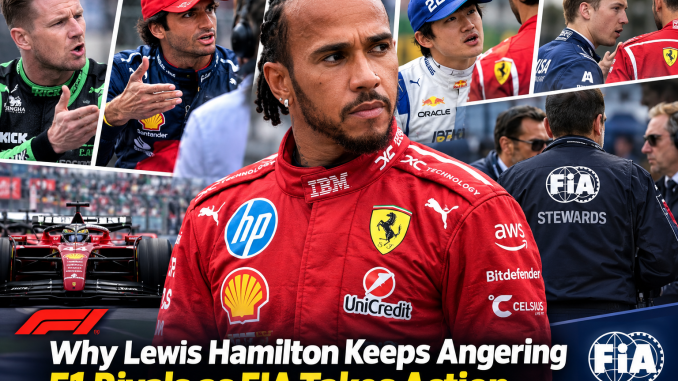
Why Lewis Hamilton Keeps Angering F1 Rivals as FIA Takes Action
Lewis Hamilton has found himself at the centre of a growing Formula 1 controversy after a series of incidents involving the Ferrari driver and rivals who claim he has repeatedly got in their way during crucial laps.
The seven-time world champion has increasingly become a familiar name in front of the FIA stewards, with several drivers expressing frustration over team radio after encountering Hamilton while attempting to complete fast laps.
While most of the incidents have happened during practice sessions and have resulted in little more than reprimands or fines, the frequency of the complaints has raised questions about whether Hamilton and Ferrari need to change their approach when managing traffic on track.
Hamilton’s most significant impeding incident of the season came before the summer break at the Hungarian Grand Prix. The Ferrari driver was judged to have impeded Oscar Piastri during qualifying and was handed a grid penalty as a result.
The punishment proved costly, with Hamilton dropping from second place on the starting grid to fifth. It was a rare example of one of his traffic-related incidents directly affecting his competitive position on a Grand Prix weekend.
Since the summer break, however, the complaints have continued to arrive.
At the Madring, Hamilton was not summoned to the stewards over any of the incidents, but several drivers were clearly unhappy with the Ferrari star’s positioning.
Nico Hulkenberg was among the first to voice his frustration after encountering Hamilton at the final complex of the circuit. The German believed Hamilton could have done more to get out of his way and allow him to complete his lap without unnecessary disruption.
Carlos Sainz was also unhappy after Hamilton allowed him through at La Monumental. The Spaniard felt Hamilton had not moved sufficiently to the left, leaving him squeezed towards the bottom of the circuit.
Sainz made his frustration clear over team radio, arguing that Hamilton could have given him significantly more room without making any meaningful difference to his own lap.
The tight nature of the street circuit certainly did not help matters. With walls close to the racing line and limited opportunities for slower cars to move completely out of the way, even a relatively small positioning error could make a significant difference to a driver attempting to complete a fast lap.
Arvid Lindblad and Yuki Tsunoda were also among those to express frustration over radio during the weekend.
Despite the complaints, none of those incidents resulted in Hamilton being called before the FIA stewards.
The situation became more serious at the Azerbaijan Grand Prix, however, when Hamilton was investigated for impeding Liam Lawson.
On that occasion, the FIA stewards issued Hamilton with a formal reprimand. Their decision was particularly notable because the stewards pointed out that Hamilton had already received two warnings from Ferrari informing him that the Racing Bulls driver was approaching.
That detail made it more difficult to place the responsibility entirely on the Ferrari pit wall.
The incident has therefore reignited debate over whether Hamilton’s recent problems are primarily caused by the driver himself, Ferrari’s communication, or simply the unpredictable nature of traffic during an F1 weekend.
There was another notable case at Sepang involving Gabriel Bortoleto. Ferrari was fined following an incident in which Hamilton impeded the Brazilian driver.
Hamilton explained that he had struggled to see the approaching car because of visibility issues with his right-hand mirror. Some observers subsequently questioned why Ferrari had not warned him about Bortoleto.
However, the circumstances were slightly different from the Lawson incident. Bortoleto was not on a push lap at the time, meaning Ferrari’s normal radio warning procedure did not necessarily require the team to alert Hamilton in the same manner.
That distinction is important because it demonstrates why simply blaming Ferrari for every Hamilton impeding incident may be an oversimplification.
Hamilton himself has also faced criticism, particularly when the stewards believe he has received sufficient warning from his team.
The bigger question, therefore, is why the seven-time world champion appears to be involved in so many of these situations.
One explanation is simply that Formula 1 drivers are extremely sensitive when another car interferes with a qualifying or practice lap. A driver can spend an entire session preparing tyres, positioning the car and building a perfect lap, only for a slower car to appear at exactly the wrong moment.
The frustration is often amplified because the difference in speed can be enormous.
A driver on a qualifying lap may be travelling at full attack while another car is cruising at dramatically lower speed. Even when the slower driver is technically following the rules, the approaching driver can feel as though their entire lap has been ruined.
That is why team radio frequently produces dramatic reactions during impeding incidents.
Drivers regularly describe rivals as dangerous, careless or chronic offenders, even though similar complaints are made against almost everyone on the grid.
Hamilton is certainly not the only driver who has been accused of impeding. What makes his recent run particularly noticeable is his status, his Ferrari profile and the number of rivals who have publicly expressed frustration with him.
For Ferrari, the priority will be preventing these incidents from becoming a recurring distraction.
Hamilton remains one of the biggest names in the sport, and every controversial moment involving the 41-year-old attracts significantly more attention than a similar incident involving a lesser-known driver.
The FIA’s recent actions also show that officials are willing to intervene when the circumstances warrant it. Although Hamilton has avoided a string of serious grid penalties, the Hungarian penalty and Azerbaijan reprimand demonstrate that repeated traffic-related incidents can eventually carry consequences.
For now, the evidence suggests that Hamilton is not deliberately trying to interfere with his rivals.
Instead, the recent incidents appear to be a combination of traffic management, communication, circuit characteristics and the intense emotions that accompany modern Formula 1.
Nevertheless, Ferrari will need to be more careful.
With the championship battle continuing and every qualifying position becoming increasingly valuable, Hamilton cannot afford to keep giving rivals reasons to complain or give the FIA opportunities to punish him.
The seven-time world champion may be getting increasingly familiar with the stewards’ room, but the simplest solution could be to make sure he does not have to visit it at all.
Discover more from F1 Paddock Updates
Subscribe to get the latest posts sent to your email.

Be the first to comment