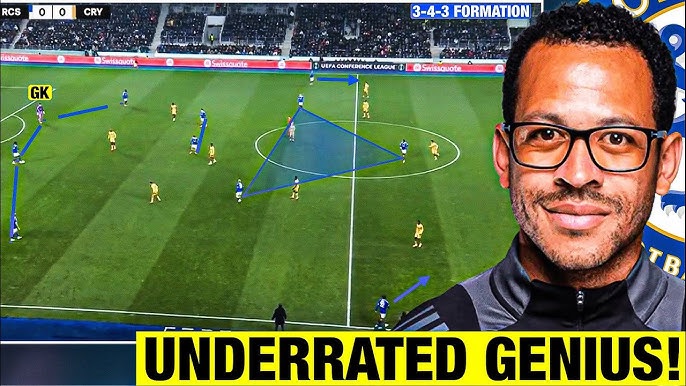
Enzo Maresca’s abrupt exit at the dawn of the new year could swiftly be succeeded by the appointment of Rosenior, who has impressed observers during his tenure with BlueCo’s sister club Strasbourg and is widely regarded as the frontrunner to step into Maresca’s shoes.
Although Rosenior may already possess familiarity with the BlueCo operational framework, his arrival at Stamford Bridge would likely herald a substantial tactical overhaul if his work in France offers any indication of what’s to come.

Here’s a comprehensive look at how Chelsea might be configured under his stewardship should he assume control.
His Strasbourg outfit employs an aggressive high press and demands relentless, tireless running to overwhelm adversaries, with a particular emphasis on forcing defensive errors and exploiting them with ruthless efficiency.
“The tactical philosophy centers around recovering possession as swiftly as possible, neutralizing the opposition’s control of the ball, and establishing dominance as far up the field as we can achieve,” Rosenior explained to Ligue 1 media outlets.
Furthermore, Strasbourg seldom resort to direct, long-range passing, instead demonstrating a clear preference for rapid, intricate short passes that originate from the defensive line and frequently involve the goalkeeper, who plays an active and integral role in the initial phase of build-up play.
When advancing the ball into attacking territories, Rosenior’s Strasbourg don’t deploy conventional wide forwards. He gravitates toward wing backs complemented by central attacking midfielders, an approach that would inevitably pose challenges for Chelsea’s costly collection of traditional wide players.
That said, Rosenior has consistently emphasized his commitment to constructing a tactical framework around the personnel at his disposal, rather than rigidly adhering to predetermined principles, which leaves room for unexpected tactical innovations.

How Chelsea Could Line Up Under Liam Rosenior’s Leadership
GK: Robert Sánchez—The Maresca era concluded with Sánchez showcasing outstanding form, though questions will perpetually linger regarding his technical proficiency with the ball at his feet. Nevertheless, the Spanish shot-stopper demonstrates courage in possession and that attribute would resonate strongly with Rosenior’s philosophy.
CB: Wesley Fofana—The right-sided defensive position in Rosenior’s tactical blueprint demands a player comfortable operating both centrally and in wider territories. Fofana represents Chelsea’s most capable option for this assignment, though Trevoh Chalobah, Josh Acheampong and even Reece James all possess the versatility to excel here.
CB: Levi Colwill—Once Colwill regains full fitness, he’ll command this central defensive position without question. Until that moment arrives, however, anticipate the continued presence of figures like Chalobah or Tosin Adarabioyo deputizing as they did throughout Maresca’s reign.
CB: Jorrel Hato—Hato stands to become a substantial beneficiary of the reintroduction of a three-centre-back system at Stamford Bridge, though it wouldn’t be remotely surprising to witness Marc Cucurella or Benoît Badiashile entrusted with this position over the long term.
RM: Reece James—All attention will fixate here, on an aggressive wing back assignment that demands the kind of relentless, high-intensity running that has been conspicuously absent from James’s performances in recent campaigns. He was genuinely among the world’s elite when operating in this capacity under Thomas Tuchel’s management and will harbor ambitions of recapturing that brilliance. Should he struggle, expect Malo Gusto to step in or perhaps even some carefully selected minutes for Estêvão in appropriate matchups.
CM: Moisés Caicedo—The likelihood is you require minimal persuasion regarding Caicedo’s automatic inclusion. He ranks among the world’s finest defensive midfielders and would be charged with flourishing in a dynamic box-to-box capacity.
CM: Enzo Fernández—While Andrey Santos enjoys the advantage of previous collaboration with Rosenior, Fernández will maintain his status as an indispensable component of Chelsea’s lineup going forward. His exceptional composure in possession would render him invaluable during build-up phases from deep positions, though occasional deployments in an advanced midfield position could open opportunities for Santos to feature.
LM: Marc Cucurella—On the surface, this could potentially represent the most vulnerable area of the squad under Rosenior’s direction. Cucurella delivered exceptional performances under Maresca but conducted the majority of his finest work through central channels, whereas a scarcity of credible alternatives would compel him into a wing back assignment in this configuration.
AM: Cole Palmer—One of the principal challenges confronting Maresca’s successor will be extracting Palmer’s maximum potential. Operating within Rosenior’s framework, the English maestro would be deployed in this interior attacking pocket, granted substantial attacking license and creative freedom.
AM: Estêvão—There’s been considerable discussion surrounding Chelsea’s long-term developmental blueprint for Estêvão, predominantly recognized as a wide player but seemingly destined for a more central attacking function. Rosenior’s tactical setup would provide this platform for the talented Brazilian prodigy, who could rotate minutes with Enzo Fernández or João Pedro depending on match circumstances.
ST: João Pedro—This represents a challenging position to definitively assign as it could, and probably will, be distributed among Pedro, Liam Delap and the imminent acquisition Emmanuel Emegha from Rosenior’s current Strasbourg roster. Strikers are instructed to cover enormous ground—constantly—and attempt to exploit offside lines for early delivery into dangerous areas.